

Are you taking Tirzepatide? Can Tirzepatide Nausea and Vomiting
Quick Answer
Tirzepatide nausea and vomiting are the most commonly reported side effects of this medication, affecting roughly 20–30% of people who use it. [1][3] These symptoms are dose-dependent, meaning they tend to peak after starting treatment or stepping up to a higher dose, and they typically ease within several weeks as the body adjusts. Dietary changes, slower dose titration, and in some cases anti-nausea medication can significantly reduce discomfort.
Key Takeaways
- Nausea affects approximately 20–30% of tirzepatide users, with vomiting occurring less frequently but still notably in clinical trials. [1][3]
- Symptoms are dose-dependent: they increase as the dose steps up and are most common in the first few weeks at each new level.
- Most nausea and vomiting is mild to moderate and improves over time as the body adapts to slower gastric emptying. [3]
- Eating smaller meals, avoiding fatty or spicy foods, and staying upright after eating are the most effective first-line strategies. [4][5]
- Anti-nausea medications such as ondansetron may be appropriate when lifestyle changes aren’t enough — always discuss with a healthcare provider. [5]
- Persistent or worsening vomiting beyond the first few weeks warrants a call to a doctor, as it can signal dehydration or, rarely, a more serious condition. [2]
- Compared to semaglutide, tirzepatide may produce fewer GI side effects at equivalent or greater effectiveness, though both carry substantial rates of nausea. [7][10]
- Starting at the lowest dose (2.5mg) and titrating slowly is the single most effective way to minimise stomach-related side effects from the outset.
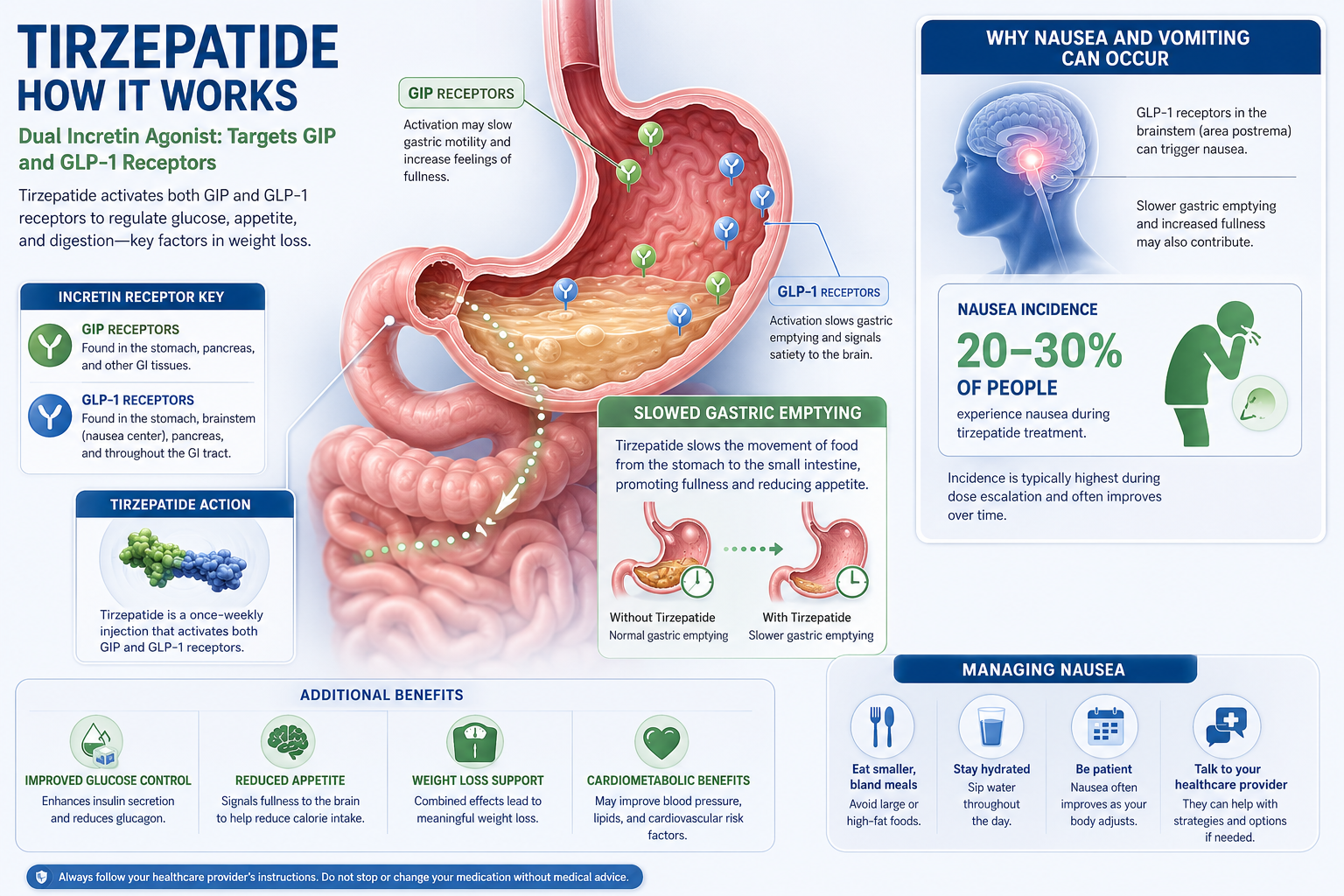
Why Does Tirzepatide Cause Nausea?
Tirzepatide causes nausea primarily because it slows gastric emptying — the rate at which food moves from the stomach into the small intestine. As a dual GIP and GLP-1 receptor agonist, it activates hormone receptors that regulate appetite and digestion, and this action directly affects how quickly the stomach processes a meal. [6]
When food sits in the stomach longer than usual, the resulting fullness and pressure can trigger nausea, especially in the early weeks of treatment or after a dose increase. The GLP-1 receptor activation also influences areas of the brain involved in nausea signalling, which compounds the effect. [2][6]
Key mechanisms at play:
- Delayed gastric emptying — food stays in the stomach longer, causing bloating and queasiness
- Central nervous system effects — GLP-1 receptors in the brainstem are linked to nausea responses
- Appetite suppression signals — the body interprets strong satiety signals as discomfort until it adapts
- Dose escalation — each step up in dose temporarily amplifies these effects before the body recalibrates [1]
Quick example: Someone moving from Tirzepatide 5mg to Tirzepatide 7.5mg may notice a return of mild nausea for one to two weeks, even if they had no symptoms at the lower dose. This is expected and usually temporary.
What Percentage of People Experience Nausea With Tirzepatide?
Nausea is the single most commonly reported side effect in tirzepatide clinical trials. Across the SURPASS (type 2 diabetes) and SURMOUNT (body composition management) trial programmes, nausea was reported in approximately 20–24% of participants on lower doses and up to 24–30% on higher doses. [1][3]
Vomiting occurred less frequently — roughly 8–13% across dose ranges — while diarrhoea was also common. [1][6]
| Side Effect | Approximate Incidence (All Doses) |
|---|---|
| Nausea | 20–30% |
| Diarrhoea | 17–22% |
| Vomiting | 8–13% |
| Decreased appetite | 20–24% |
| Constipation | 11–17% |
Data sourced from SURPASS/SURMOUNT trial summaries as reported in GoodRx and Fella Health clinical reviews. [1][3]
Important context: The majority of people who experienced nausea described it as mild to moderate. Severe nausea leading to discontinuation was relatively uncommon in trials. [6]
How Long Does Nausea Last When Taking Tirzepatide?
For most people, nausea from tirzepatide is temporary. Symptoms typically peak in the first one to two weeks after starting a new dose and then gradually improve over the following two to four weeks as the body adapts. [3]
Fella Health’s review of FDA and SURMOUNT data notes that nausea “typically improves within several weeks” as the body adjusts to altered gastric emptying. [3] This pattern tends to repeat — at a milder level — each time the dose steps up.
General timeline:
- Week 1–2 at a new dose: Nausea most likely, especially after meals
- Week 3–4: Symptoms usually begin to ease noticeably
- Week 5+: Most users report little to no nausea at a stable dose
- Dose increase: The cycle may restart briefly at a lower intensity
Common mistake: Stopping tirzepatide entirely after the first wave of nausea, before the body has had time to adjust. Many people who push through the initial adaptation period find symptoms resolve on their own with simple dietary changes.
Does Nausea Get Better Over Time With Tirzepatide?
Yes — in the vast majority of cases, tirzepatide-related nausea improves significantly over time. The body’s adaptation to slower gastric emptying is a well-documented pattern with GLP-1 and dual GIP/GLP-1 receptor agonists. [2][3]
That said, a small proportion of users find that nausea persists or returns with each dose escalation. For these individuals, a slower titration schedule — staying at a lower dose for longer before stepping up — is often the most effective solution. [5]
Choose a slower titration if:
- Nausea is still present after four weeks at the current dose
- Vomiting has occurred more than once in a week
- Appetite suppression is so strong that eating adequate nutrition is difficult
For guidance on what to expect at each dose level, the effects of Tirzepatide 2.5mg and effects of Tirzepatide 5mg pages provide useful starting-point information.
What Foods Help Reduce Nausea While on Tirzepatide?
Diet is the most immediately controllable factor in managing tirzepatide-related nausea. Because the medication slows gastric emptying, the type and size of meals eaten directly influences how uncomfortable the stomach feels. [4][5]
Foods and habits that help:
- Plain, low-fat foods — crackers, dry toast, plain rice, boiled chicken, bananas
- Small, frequent meals — eating every 3–4 hours rather than three large meals
- Ginger — ginger tea, ginger chews, or ginger biscuits have a well-established role in reducing nausea
- Cold or room-temperature foods — hot, steaming meals can intensify nausea
- Staying upright for 30–60 minutes after eating — lying down after a meal worsens the sensation of fullness
Foods and habits that make nausea worse:
- High-fat, greasy, or fried foods (chips, fast food, pastries)
- Spicy dishes
- Very large portion sizes
- Eating quickly
- Alcohol (which also irritates the stomach lining)
- Carbonated drinks, which increase bloating [4][5]
💡 Practical tip: Eating a small snack — a few plain crackers or a banana — about 20 minutes before the meal can help buffer the stomach and reduce queasiness.

Tips to Reduce Nausea With Tirzepatide (Mounjaro/Zepbound)
The most effective approach to managing tirzepatide nausea and vomiting combines slow dose escalation with consistent dietary adjustments. Clinical guidance from multiple sources consistently highlights the same core strategies. [4][5]
Step-by-step management checklist:
- ✅ Start at the lowest dose (2.5mg) and do not rush the titration schedule
- ✅ Eat smaller portions — aim for meals that are roughly half your usual size at first
- ✅ Avoid trigger foods — greasy, spicy, and very rich foods are the biggest culprits
- ✅ Stay hydrated — sip water steadily throughout the day rather than drinking large amounts at once
- ✅ Time your injection — some people find injecting in the evening means peak side effects occur during sleep
- ✅ Sit upright after eating — avoid lying down for at least an hour after meals
- ✅ Try ginger — ginger tea or ginger chews before meals can be surprisingly effective
- ✅ Avoid alcohol — it compounds GI irritation significantly
- ✅ Don’t skip meals entirely — an empty stomach can actually worsen nausea on this medication [4][5]
For those on a body composition management journey who are also incorporating exercise, it’s worth noting that exercising immediately after eating while on tirzepatide can intensify nausea. The guide on tirzepatide and exercise covers timing strategies in more detail.
Can You Take Anti-Nausea Medication With Tirzepatide?
Yes, anti-nausea medications can be used alongside tirzepatide when dietary and lifestyle changes are not enough. Clinicians may recommend over-the-counter or prescription options depending on severity. [5]
Commonly considered options:
- Ondansetron (Zofran) — a prescription antiemetic often used for moderate to severe nausea; clinician review required
- Domperidone — available in the UK, helps speed gastric emptying and can counteract tirzepatide’s slowing effect
- Cyclizine — an antihistamine-based antiemetic available over the counter in the UK
- Metoclopramide — prescription only; helps with gastric motility but carries some caution for long-term use
Important: Always discuss anti-nausea medication with a healthcare provider before starting. Some antiemetics interact with other medications, and the underlying cause of vomiting should be assessed before masking it with medication. [5][8]
Common mistake: Using anti-nausea medication to push through severe, persistent vomiting without seeking medical advice. If vomiting is frequent enough to require daily antiemetics, the tirzepatide dose or titration schedule likely needs reassessment.
Is Vomiting a Serious Side Effect of Tirzepatide?
For most people, vomiting on tirzepatide is not serious — it is a GI side effect that resolves as the body adapts. However, frequent or severe vomiting does carry real risks and should not be ignored. [2][8]
When vomiting is a concern:
- Dehydration — repeated vomiting prevents adequate fluid intake, which can become medically significant
- Electrolyte imbalance — loss of fluids and stomach acid disrupts sodium, potassium, and chloride levels
- Inability to take other medications — vomiting can prevent absorption of other essential drugs
- Pancreatitis (rare) — severe abdominal pain accompanied by vomiting may indicate pancreatic inflammation, a rare but serious adverse event [6][8]
- Bowel obstruction (rare) — extremely slowed gut motility in susceptible individuals can, in rare cases, progress to obstruction [2]
The Mayo Clinic’s tirzepatide prescribing information flags severe abdominal pain, persistent vomiting, and signs of dehydration as reasons to seek immediate medical attention. [8]
When Should You Call Your Doctor About Nausea From Tirzepatide?
Call a healthcare provider promptly if nausea and vomiting from tirzepatide are persistent, worsening, or accompanied by other symptoms. Mild nausea in the first few weeks is expected — but certain patterns signal something that needs clinical review. [2][8]
Call your doctor if:
- Vomiting occurs more than two to three times per day
- Nausea has not improved after four or more weeks at the same dose
- You are unable to keep fluids down for more than 24 hours
- You notice signs of dehydration (dark urine, dizziness, dry mouth)
- Abdominal pain accompanies the vomiting — especially severe, persistent pain
- You notice a lump or swelling in your neck, hoarseness, or difficulty swallowing (see safety warning below)
- Symptoms worsen after a dose increase and do not settle within two weeks [2][5][8]
⚠️ Important Medical Warning: Contact your healthcare provider promptly if you notice a lump or swelling in your neck, persistent hoarseness, difficulty swallowing, or shortness of breath. These symptoms may require medical evaluation. In animal studies, tirzepatide and similar medications were associated with thyroid tumours. It is not known whether TIRZEPARO® causes thyroid tumours or medullary thyroid carcinoma (MTC) in humans. You must be 18+ to use our service.
Are Some People More Likely to Get Nauseous on Tirzepatide?
Yes. Certain factors increase the likelihood of experiencing nausea and vomiting on tirzepatide. Understanding these risk factors helps set realistic expectations and allows for proactive management. [1][5]
Higher-risk profiles:
- Women — clinical trial data consistently show women report GI side effects at higher rates than men
- People with a history of GI sensitivity — those who experience motion sickness, nausea during pregnancy, or sensitivity to other medications
- Rapid dose escalation — moving through dose steps faster than the recommended schedule significantly increases GI side effects
- Large meal habits — people accustomed to eating large portions find the adjustment to smaller meals more difficult
- High-fat diet — a diet rich in fried or greasy foods amplifies the effect of slowed gastric emptying [4][5]
Lower-risk profiles:
- People who naturally eat smaller, lower-fat meals
- Those who start at 2.5mg and follow a slow, steady titration
- Individuals with no prior history of GI sensitivity
Can You Still Take Tirzepatide If You’re Vomiting?
This depends on the frequency and severity of vomiting. Occasional vomiting — once or twice in the first week at a new dose — does not necessarily mean tirzepatide needs to be stopped. However, if vomiting is frequent, persistent, or preventing adequate nutrition and hydration, the dose should be reassessed. [5][8]
Practical guidance:
- Mild, infrequent vomiting: Continue at the current dose, apply dietary strategies, and monitor closely
- Moderate vomiting (2–3 episodes per day): Contact a healthcare provider; a dose reduction or titration pause may be recommended
- Severe or daily vomiting: Do not continue without medical guidance — dehydration and electrolyte imbalance are genuine risks
- Vomiting with severe abdominal pain: Seek urgent medical attention to rule out pancreatitis [6][8]
A dose reduction — for example, stepping back from Tirzepatide 10mg to a lower maintenance level — is a legitimate clinical strategy and does not mean treatment has failed.
How Does Tirzepatide’s GI Profile Compare to Other Medications?
Tirzepatide’s nausea and vomiting rates are broadly similar to those of semaglutide (Ozempic/Wegovy) but may be slightly more favourable at comparable effectiveness levels. A 2025 Penn Nursing-linked analysis found that tirzepatide produced “significantly fewer side effects” such as nausea and vomiting compared to semaglutide at doses achieving comparable reductions in food intake and body composition changes. [7]
A 2025 comparative study published in Therapie (ScienceDirect) found that while both semaglutide and tirzepatide carry substantial GI adverse event rates, tirzepatide often showed similar or slightly lower incidence at equivalent or greater efficacy. [10]
| Medication | Nausea Rate (Approx.) | Vomiting Rate (Approx.) | Mechanism |
|---|---|---|---|
| Tirzepatide | 20–30% | 8–13% | Dual GIP + GLP-1 agonist |
| Semaglutide | 25–44% | 10–24% | GLP-1 agonist only |
| Liraglutide | 28–40% | 11–16% | GLP-1 agonist only |
Rates are approximate ranges drawn from respective clinical trial programmes and comparative reviews. [1][7][10]
For a deeper comparison of tirzepatide versus semaglutide across multiple factors, the Tirzepatide vs Semaglutide guide covers the evidence in detail.
FAQ: Tirzepatide Nausea and Vomiting
Q: Does everyone get nausea on tirzepatide?
No. Approximately 70–80% of people do not experience significant nausea. Roughly 20–30% report it, and most of those describe it as mild to moderate. [1][3]
Q: Is nausea worse at higher doses of tirzepatide?
Yes. Nausea is dose-dependent. It is least common at 2.5mg and most common at higher doses such as 10mg, 12.5mg, and 15mg. [1][6]
Q: Does injecting tirzepatide in the evening reduce nausea?
Some users find that evening injections mean peak side effects occur during sleep, reducing the perceived impact of nausea. This is a practical strategy worth trying, though evidence is anecdotal rather than from controlled trials.
Q: Can I eat normally while on tirzepatide?
Eating “normally” in terms of large portions or high-fat meals is likely to worsen nausea significantly. Smaller, lower-fat meals are strongly recommended, especially in the first weeks at each dose level. [4][5]
Q: How long should I wait before deciding tirzepatide nausea is not going to improve?
Give each dose level at least four weeks before concluding that nausea is not settling. If symptoms remain significant after four weeks with dietary adjustments in place, discuss a slower titration or dose reduction with a healthcare provider. [3][5]
Q: Will I vomit every time I inject tirzepatide?
No. Vomiting is less common than nausea and is not an inevitable part of treatment. If vomiting is occurring regularly, it is a sign that the current dose or titration pace needs review. [1][8]
Q: Can dehydration from vomiting be dangerous on tirzepatide?
Yes. Repeated vomiting can lead to dehydration and electrolyte imbalance. If you cannot keep fluids down for more than 24 hours, seek medical attention. [2][8]
Q: Is ginger actually effective for tirzepatide nausea?
Ginger has a well-established evidence base for reducing nausea across multiple contexts (pregnancy, chemotherapy, motion sickness). While there are no tirzepatide-specific trials on ginger, clinical guidance consistently includes it as a practical, low-risk option. [4][5]
Q: Should I stop tirzepatide if I vomit once?
Not necessarily. A single episode of vomiting in the first week at a new dose is common and not a reason to stop. Persistent or severe vomiting is the threshold for seeking advice. [5]
Q: Does tirzepatide cause nausea on an empty stomach?
Yes — taking tirzepatide (or eating too little) can actually worsen nausea. Keeping something small in the stomach, particularly around mealtimes, tends to reduce queasiness. [4]
Conclusion: Managing Tirzepatide Nausea and Vomiting Effectively
Tirzepatide nausea and vomiting are real, common, and manageable. They affect roughly one in four users, are most pronounced in the early weeks of treatment or after each dose increase, and resolve for the majority of people within a few weeks. [1][3]
The evidence is clear on what works: start at the lowest dose, titrate slowly, eat smaller and lower-fat meals, stay hydrated, and give the body time to adapt. When dietary strategies are not enough, anti-nausea medications are available options to discuss with a healthcare provider. [4][5]
Actionable next steps:
- If you’re just starting out, begin with Tirzeparo® 2.5mg — the starting dose is specifically designed to minimise GI side effects during the adaptation period.
- Review your diet before your first injection. Identify any high-fat or spicy staples that may need to be temporarily reduced.
- Track your symptoms week by week. Knowing whether nausea is improving, stable, or worsening helps inform decisions about titration.
- Don’t push through severe vomiting alone. Reach out to a healthcare provider if symptoms are frequent, persistent, or accompanied by pain.
- Explore the full range of dosing options — from 2.5mg through to 15mg — on the Tirzeparo products page to understand the titration pathway before you begin.
For those considering tirzepatide as part of a broader body composition management approach, understanding the side effect profile upfront is one of the most practical steps towards a smoother, more sustainable experience.
Tirzeparo acts as a bridge, providing direct access to affordable Tirzepatide by fulfilling orders through our network of EU partners. We are not a medical clinic; we are your sourcing solution.
References
[1] Common Side Effects – https://www.goodrx.com/mounjaro/common-side-effects
[2] Tirzepatide Side Effects Body Reacts Meds Steps 4723e4 – https://ubiehealth.com/doctors-note/tirzepatide-side-effects-body-reacts-meds-steps-4723e4
[3] Tirzepatide Weight Loss Shot Nausea – https://www.fellahealth.com/guide/tirzepatide-weight-loss-shot-nausea
[4] What To Expect With Semaglutide Tirzepatide Side Effects How To Alleviate Them – https://hendersonwomenscare.com/what-to-expect-with-semaglutide-tirzepatide-side-effects-how-to-alleviate-them/
[5] Tirzepatide Nausea – https://www.forhers.com/blog/tirzepatide-nausea
[6] Nbk585056 – https://www.ncbi.nlm.nih.gov/books/NBK585056/
[7] 2025 09 Drug Weight Loss Side Effects – https://medicalxpress.com/news/2025-09-drug-weight-loss-side-effects.html
[8] Drg 20534045 – https://www.mayoclinic.org/drugs-supplements/tirzepatide-subcutaneous-route/description/drg-20534045
[10] S0753332225009254 – https://www.sciencedirect.com/science/article/pii/S0753332225009254