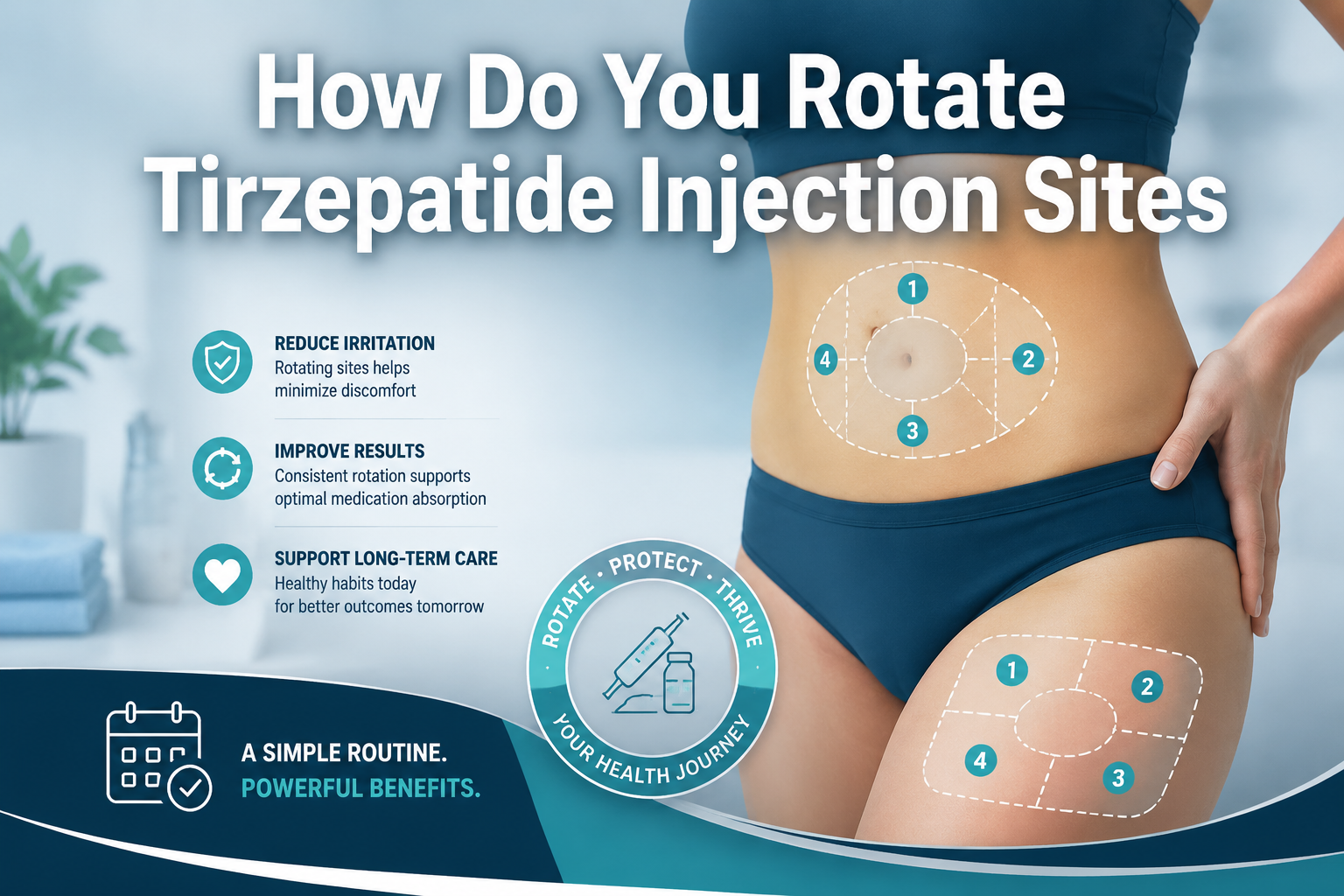
If You Are Tirzepatide Know How Do You Rotate Tirzepatide Injection Sites
Quick Answer: To rotate tirzepatide injection sites correctly, alternate between the three approved areas — the abdomen, upper thigh, and upper arm — with every weekly dose. Never inject in the exact same spot twice in a row. Move at least 1 inch (2–3 cm) from your previous injection point each time. This protects the skin, prevents scar tissue, and keeps medication absorption consistent.
Key Takeaways
- Three approved injection zones: abdomen, upper thigh, and upper arm — all considered clinically equivalent for absorption [7]
- Rotate with every dose: change the site each week, not just the general area
- Minimum spacing: at least 1 inch (2–3 cm) between injection points [2]
- Avoid the navel: stay at least 2 inches away from the belly button and any scars or skin folds [7]
- Repeating the same spot can cause lipohypertrophy (fatty lumps under the skin) that reduces medication effectiveness [3]
- All three zones absorb tirzepatide equally well — choose based on comfort and convenience
- Pinch the skin before injecting to ensure subcutaneous (under the skin, not muscle) delivery [4]
- Bruising and soreness are common but can be reduced with proper technique and site rotation
- Scar tissue from repeated injections slows absorption and can make doses less predictable
- A rotation map or tracking log is one of the most practical tools for staying consistent week to week [2]
Where Can You Inject Tirzepatide on Your Body?
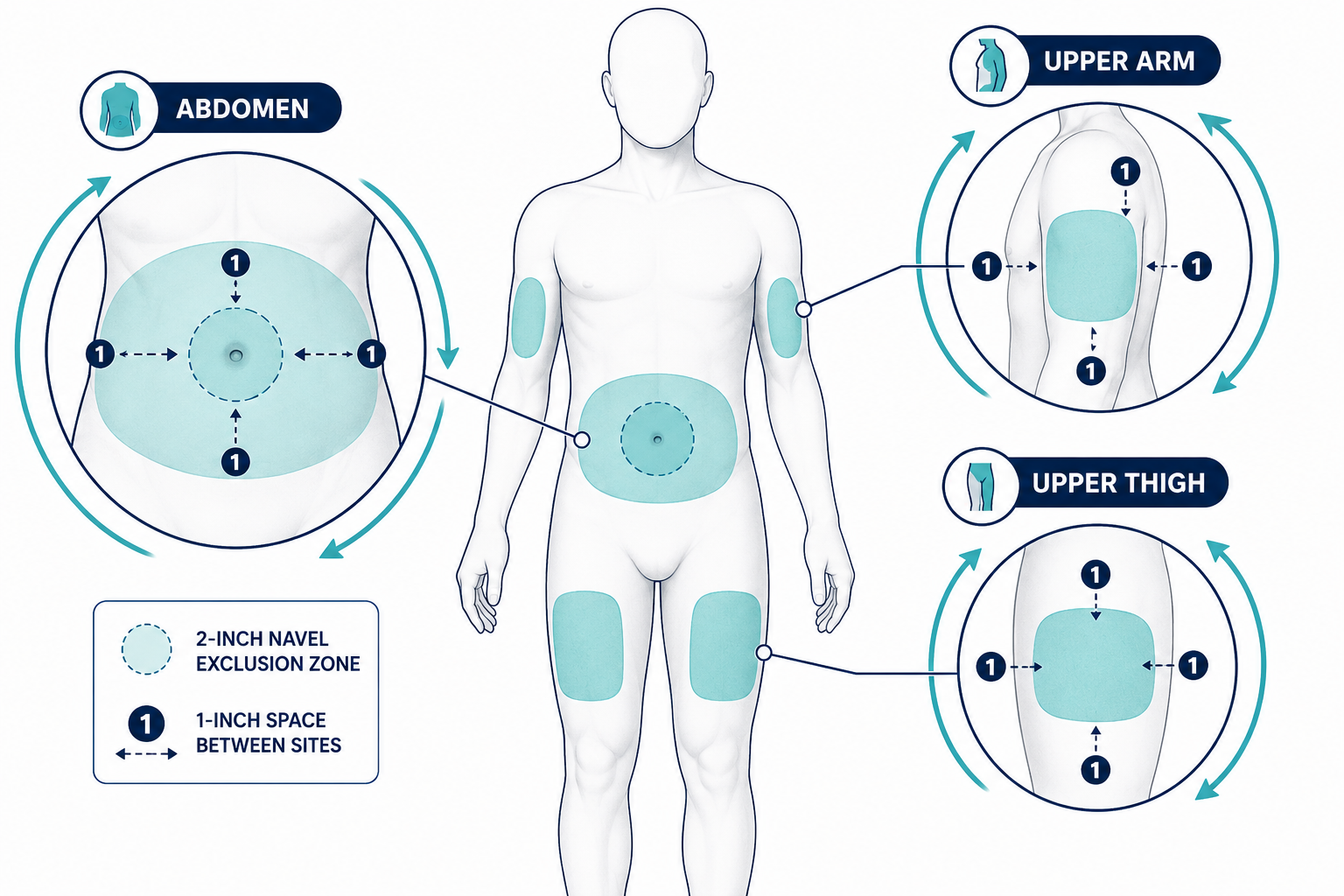
Tirzepatide is approved for subcutaneous injection in three specific body areas: the abdomen, the upper thigh, and the upper arm. These are the only three sites recommended by the prescribing guidelines, and all three are considered equivalent in terms of how well the medication is absorbed [7].
Here’s a breakdown of each zone:
Abdomen
- The most commonly used site because it’s easy to access and has a generous surface area
- Inject into the fatty tissue around the belly — but stay at least 2 inches (5 cm) away from the navel
- Avoid waistbands, scars, stretch marks, and skin folds [6]
- The lower abdomen (below the navel, to either side) tends to be the most comfortable area
Upper Thigh
- Use the front or outer side of the upper thigh, roughly midway between the knee and hip
- Avoid the inner thigh, where skin is thinner and more sensitive
- A good option when the abdomen is sore or recently used [1]
Upper Arm
- The outer, fatty area of the upper arm (the tricep region) is the approved zone
- This site is harder to self-inject — most people need assistance or a mirror for this location
- Best used when rotating away from the abdomen and thigh [8]
Decision rule: If you’re self-injecting alone, the abdomen and thigh are the easiest sites. Use the upper arm when you have help or when the other two areas need to rest.
How Do You Rotate Tirzepatide Injection Sites Effectively?
Effective rotation means systematically moving between sites so no single area is overused. The goal is to give each injection point adequate time to recover — typically at least two to four weeks before returning to the exact same spot [2].
A simple rotation system that works:
- Divide each zone into sections. The abdomen, for example, can be split into four quadrants (upper-left, upper-right, lower-left, lower-right). The same logic applies to each thigh.
- Rotate through sections before repeating. Instead of always injecting into the lower-left abdomen, move clockwise through all quadrants before returning.
- Track your sites. Use a notebook, a phone note, or a printed rotation map to record where you injected each week [2].
- Switch zones every few weeks. Spending two to three weeks on the abdomen, then moving to the thigh, then the arm, then back again is a structured approach many people find easy to follow.
Example 8-week rotation schedule:
| Week | Zone | Side/Quadrant |
|---|---|---|
| 1 | Abdomen | Lower-left |
| 2 | Abdomen | Lower-right |
| 3 | Upper thigh | Left |
| 4 | Upper thigh | Right |
| 5 | Abdomen | Upper-left |
| 6 | Abdomen | Upper-right |
| 7 | Upper arm | Left |
| 8 | Upper arm | Right |
This kind of structured plan ensures each area gets adequate recovery time and keeps your injection routine predictable.
How Often Should You Change Injection Sites?
Change your injection site with every single weekly dose — not just occasionally. The general rule is to never inject in the exact same spot twice in a row, and to move at least 1 inch (approximately 2–3 cm) from your last injection point [2][3].
Tirzepatide is a weekly injection, which means each site has seven days to recover before the next dose. That’s enough time for minor irritation to resolve — but only if you’re not repeatedly returning to the same small patch of skin.
Common mistake: Many people rotate between zones (e.g., abdomen one week, thigh the next) but always inject in the exact same spot within that zone. This still causes localised skin damage over time. True rotation means varying the specific point, not just the general area.
Can You Use the Same Spot Twice for Tirzepatide?
No — using the exact same injection point twice in a row is not recommended. Doing so repeatedly can cause a condition called lipohypertrophy: a build-up of fatty tissue under the skin that forms a lump or hardened area [3][8].
Lipohypertrophy matters for more than cosmetic reasons. Injecting into these lumps can significantly reduce how well tirzepatide is absorbed, leading to unpredictable blood levels of the medication and less consistent results on your metabolic health journey [3].
The minimum safe distance between injection points is 1 inch (2–3 cm) [2]. If you’re injecting weekly, this means you have plenty of surface area to work with — the abdomen alone offers dozens of viable injection points before you need to revisit any one spot.
What Happens If You Don’t Rotate Injection Sites?
Skipping rotation consistently leads to several problems, ranging from cosmetic to clinically significant.
Short-term effects:
- Localised pain and soreness at the injection site
- Bruising and redness that takes longer to clear
- Skin thickening or hardening under the surface
Long-term effects:
- Lipohypertrophy: Fatty lumps that develop from repeated trauma to the same tissue [3]
- Reduced absorption: Scar tissue and lipohypertrophy both impair how tirzepatide moves from the subcutaneous layer into the bloodstream [8]
- Inconsistent dosing: If absorption is impaired, the medication may not work as predictably, making it harder to manage appetite and support your body transformation goals
Think of it this way: the injection site is part of the delivery system. If the delivery system is compromised, the dose is compromised too.
Do Injection Sites Affect Medication Absorption?
All three approved tirzepatide injection sites — abdomen, thigh, and upper arm — are considered clinically equivalent for absorption when the skin is healthy [7]. However, the condition of the tissue at the injection site does affect how well the medication is absorbed.
Factors that reduce absorption:
- Injecting into scar tissue or lipohypertrophy lumps [3]
- Injecting into inflamed or bruised skin
- Accidentally injecting into muscle rather than subcutaneous fat (this can speed absorption unpredictably and increase pain) [4]
Factors that support consistent absorption:
- Rotating sites regularly so tissue stays healthy
- Pinching the skin to ensure subcutaneous delivery
- Injecting at room temperature (cold medication from the fridge can cause more discomfort and may affect local tissue response) [8]
If you’re curious about how tirzepatide works at different doses and what to expect as you step up, the guides on what to expect from Tirzepatide 5mg and Tirzepatide 7.5mg effects offer useful context.
Differences Between Stomach, Thigh, and Arm Injections
Each injection zone has practical trade-offs. The medication works the same regardless of which site you choose, but your experience of injecting — and how easy it is to do correctly — varies between locations [1][6].
| Feature | Abdomen | Upper Thigh | Upper Arm |
|---|---|---|---|
| Ease of self-injection | ✅ Easy | ✅ Easy | ⚠️ Harder alone |
| Surface area available | Large | Medium | Small |
| Common discomfort | Mild | Mild | Moderate |
| Risk of hitting muscle | Low (with pinch) | Low (with pinch) | Moderate |
| Best for | Most people | Active rotation | When other sites need rest |
Key differences to know:
- The abdomen has the most available surface area, making it the easiest zone to rotate within. It’s also the most commonly recommended starting point [6].
- The upper thigh is a natural choice when the abdomen needs a break. It’s particularly easy to access when seated.
- The upper arm requires more care to avoid injecting too deep into muscle. If you’re using this site alone, a 45-degree angle (rather than 90 degrees) may help ensure subcutaneous delivery [8].
How to Prevent Bruising With Tirzepatide Shots
Bruising is one of the most common complaints with subcutaneous injections, but it’s largely preventable with the right technique.
Steps to reduce bruising:
- Let the pen reach room temperature before injecting. Cold medication causes more tissue trauma [8].
- Don’t rub the injection site after removing the pen. Rubbing can spread the medication into surrounding tissue and increase bruising.
- Inject slowly and steadily. Rushing the injection increases the likelihood of trauma to small blood vessels.
- Pinch the skin firmly before injecting to lift subcutaneous tissue away from muscle.
- Avoid areas with visible veins or surface blood vessels.
- Rotate consistently — bruised or recently used skin is more prone to further bruising.
- Apply light pressure (not rubbing) with a clean cotton pad after the injection if there is minor bleeding.
If bruising is persistent or severe, speak with a healthcare professional. Occasional minor bruising is normal; large or frequent bruises are worth discussing.
Tips for Reducing Pain When Rotating Injection Sites
Pain with tirzepatide injections is usually mild and brief, but a few practical adjustments make a noticeable difference.
Before the injection:
- Remove the pen from the fridge 20–30 minutes before injecting. Room-temperature medication stings less [4].
- Clean the skin with an alcohol swab and let it dry fully before injecting. Wet skin can sting.
- Relax the muscle in the target area — tensing up increases pain.
During the injection:
- Pinch the skin firmly to create a subcutaneous “tent” of tissue.
- Insert the needle at a 90-degree angle for the abdomen and thigh (45 degrees if you have less subcutaneous fat or are using the arm).
- Hold the pen in place for the full count recommended in the device instructions before removing [4].
After the injection:
- Apply gentle pressure with a clean pad — do not rub.
- Avoid strenuous exercise involving the injected area for a few hours.
If a particular zone consistently causes more pain than others, shift to a different area for a few weeks. Pain that is sharp, prolonged, or accompanied by swelling warrants medical attention.
Am I Doing Tirzepatide Injections Correctly? A Quick Checklist
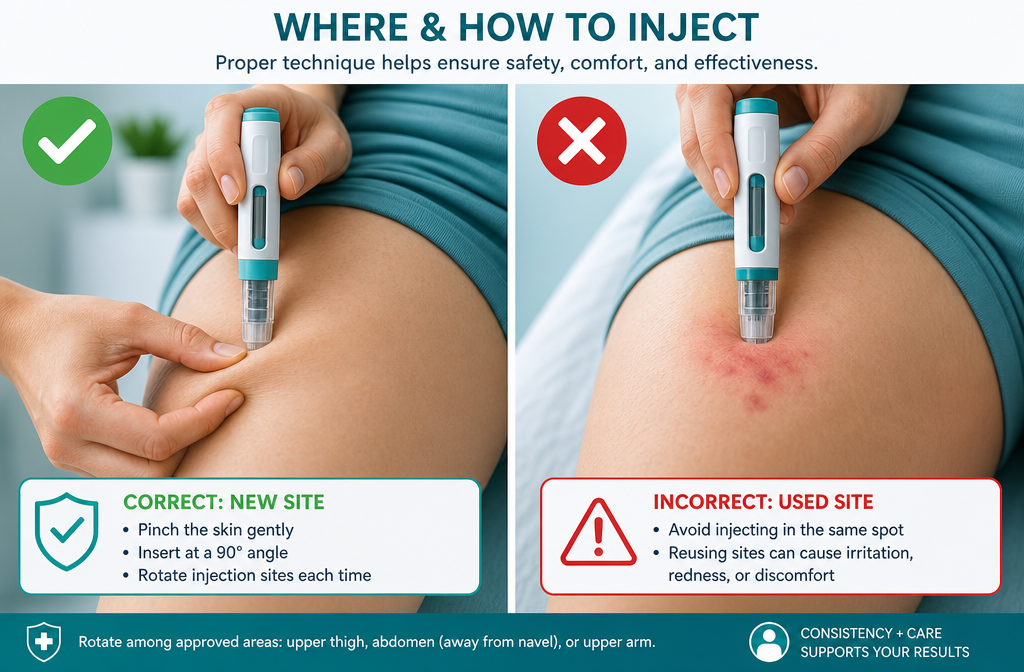
Use this checklist before and after each injection to confirm correct technique [4][7][8]:
Before injecting:
- Pen has been out of the fridge for at least 20 minutes
- Hands are clean and dry
- Injection site is clean and dry (alcohol swab used and dried)
- Site is free from bruising, lumps, or active irritation
- New needle attached (if applicable for your pen type)
During injection:
- Skin is pinched firmly to lift subcutaneous tissue
- Needle inserted at correct angle (90° for most sites)
- Pen held steady until the full dose is delivered
- Pen held in place for the recommended count before removal
After injecting:
- Gentle pressure applied — no rubbing
- Injection site and date recorded in your log
- Used pen/needle disposed of safely in a sharps container
If you’re new to tirzepatide and want to understand the full dosing journey from 2.5mg upward, the Tirzepatide 2.5mg effects guide is a practical starting point.
Common Mistakes People Make With Tirzepatide Injections
Even experienced users make these errors. Knowing them in advance saves a lot of discomfort.
Mistake 1: Rotating zones but not spots
Switching from abdomen to thigh counts as rotation — but if you always inject in the same corner of the thigh, you’re still overusing that one point. Rotate within each zone as well as between zones [2].
Mistake 2: Injecting cold medication
Straight from the fridge, tirzepatide can sting significantly. Always allow the pen to reach room temperature before use [8].
Mistake 3: Injecting too close to the navel or scars
The 2-inch (5 cm) exclusion zone around the navel exists because the tissue there is less suitable for subcutaneous delivery. The same applies to scar tissue from surgery or previous injections [7].
Mistake 4: Rubbing the site after injection
This is a very common habit but it disperses the medication unevenly and increases bruising risk. Apply pressure only.
Mistake 5: Not keeping a rotation log
Without a record, it’s easy to default to the same comfortable spot every week. A simple weekly log — even a note on your phone — prevents this [2].
Mistake 6: Injecting into lipohypertrophy lumps
If you notice a lump or hardened area under the skin, avoid it. Injecting into these areas reduces absorption and perpetuates the problem [3].
How Far Apart Should Injection Sites Be?
Each injection point should be at least 1 inch (2–3 cm) away from the previous one [2]. This spacing gives the tissue enough room to recover between doses without creating a pattern of overlapping trauma.
In practical terms:
- The abdomen offers the most room — you can map out a grid of injection points across the lower and upper abdomen, each spaced 1 inch apart, giving you 10 or more distinct points before repeating any one spot.
- The upper thigh offers a smaller but still workable area — roughly 4–6 distinct points per thigh.
- The upper arm offers the least surface area, which is one reason it’s typically used as a third-rotation option rather than a primary site.
What areas are safe for Mounjaro/tirzepatide injections? Safe zones are the fatty subcutaneous tissue of the abdomen (excluding 2 inches around the navel), the front and outer upper thigh, and the outer upper arm. Avoid bony areas, joints, the inner thigh, the lower arm, and any area with active skin conditions [6][7].
What to Do If You Have Scar Tissue From Injections
Scar tissue from repeated injections — also called lipohypertrophy — is a common problem for people who haven’t been rotating consistently. The affected area feels firm or lumpy under the skin and may look slightly raised or discoloured.
Immediate steps:
- Stop injecting into or near the affected area entirely
- Map out new injection points in healthy tissue in the same or a different zone
- Give the affected area at least 4–8 weeks of complete rest before considering using it again
Longer-term management:
- Consistent rotation going forward is the most effective prevention
- Some mild lipohypertrophy resolves on its own once the area is rested
- Persistent or significant lumps should be assessed by a healthcare professional — in some cases, the tissue does not fully return to normal
Absorption impact: Scar tissue significantly impairs how tirzepatide is absorbed. If you’ve been injecting into the same area for weeks and feel the medication isn’t working as well as it should, scar tissue may be a contributing factor [3][8]. Switching to a healthy site often restores more consistent results.
For context on how tirzepatide performs at higher maintenance doses, the Tirzepatide 10mg effects guide covers what to expect as you progress through the dosing schedule.
How Do You Rotate Tirzepatide Injection Sites: A Step-by-Step Summary
For anyone who wants a single, clear reference on how to rotate tirzepatide injection sites from week to week, here is the complete process in order:
- Record last week’s site before you inject. Note the zone and approximate location.
- Choose this week’s site — a different zone or a different point within the same zone, at least 1 inch from the last injection.
- Prepare the area — clean with an alcohol swab, let dry, and allow the pen to reach room temperature.
- Inject correctly — pinch the skin, insert at 90 degrees (or 45 degrees for the arm), hold steady until the dose is complete.
- Apply gentle pressure after removing the pen. Do not rub.
- Log the site — zone, side (left/right), and date.
- Check the skin at next week’s injection time. If there’s any lump, bruising, or irritation, choose a different point.
Following this process consistently is the single most effective thing you can do to protect your skin and keep your tirzepatide working as intended.
If you’re considering starting tirzepatide or exploring your options in the UK, the Tirzeparo affordability guide and UK pricing breakdown are useful resources for understanding your options without the clinic markup.
FAQ: Tirzepatide Injection Site Rotation
Q: Can I inject tirzepatide in my buttocks?
No. The buttocks are not an approved injection site for tirzepatide. The three approved zones are the abdomen, upper thigh, and upper arm [7].
Q: Does it matter which zone I start with?
No — all three zones absorb tirzepatide equally well. Most people start with the abdomen because it’s the easiest to self-inject accurately [1].
Q: How do I know if I’ve hit muscle instead of fat?
Injecting into muscle typically causes a sharper, deeper pain and the medication may absorb faster than usual. Pinching the skin before injecting and using the correct angle reduces this risk significantly [4].
Q: Can I inject tirzepatide in the same zone as semaglutide (Ozempic/Wegovy)?
Yes — the approved zones are the same for both medications. However, avoid injecting tirzepatide and semaglutide in the same spot on the same day if you’re transitioning between medications.
Q: Is the upper arm safe for self-injection?
It can be, but it’s harder to do alone. A 45-degree angle and a mirror can help, or ask someone to assist. Many people reserve the upper arm for when the abdomen and thigh need a rest [8].
Q: How long does it take for a bruise from injection to heal?
Most minor bruises from subcutaneous injections resolve within 3–7 days. Avoid that spot until it has fully cleared.
Q: What if I accidentally inject in the wrong spot?
If you’ve injected into an unapproved area (e.g., inner thigh, forearm), monitor for unusual pain or swelling and contact a healthcare professional if concerned. A single misplaced injection is unlikely to cause serious harm, but correct technique going forward is important.
Q: Should I rotate sites if I’m only using the abdomen?
Yes. Even within the abdomen alone, you should move at least 1 inch between injection points each week and work through different quadrants before repeating any one spot [2].
Q: Does tirzepatide need to be injected at the same time each week?
It should be taken on the same day each week, but the exact time of day can vary by up to a few hours. Consistent timing supports steady medication levels [7].
Q: Can exercise affect injection site absorption?
Vigorous exercise in the injected area shortly after injection may increase local blood flow and alter absorption slightly. It’s generally recommended to avoid intense exercise targeting the injection zone for a few hours post-dose. For more on combining tirzepatide with physical activity, see the guide on tirzepatide and exercise.
Conclusion: Consistent Rotation Is Non-Negotiable
Knowing how to rotate tirzepatide injection sites correctly is not a minor detail — it directly affects how well the medication works and how comfortable your experience is week to week. The core rules are straightforward: use only the three approved zones, move at least 1 inch from your last injection point, never return to a bruised or lumpy area, and keep a log so you don’t default to the same spot out of habit.
Actionable next steps:
- Draw or print a rotation map of the abdomen, thighs, and arms and mark each injection point as you use it.
- Set a weekly reminder that includes a note on which zone to use next.
- Check your skin before each injection for any signs of lipohypertrophy or irritation.
- Let the pen warm up every time — this alone reduces most injection discomfort.
- If you’re new to tirzepatide or exploring your options, take the Tirzeparo eligibility quiz to find out which dose and plan suits your goals.
⚠️ Important Medical Warning: Contact your healthcare provider promptly if you notice a lump or swelling in your neck, persistent hoarseness, difficulty swallowing, or shortness of breath. These symptoms may require medical evaluation. In animal studies, tirzepatide and similar medications were associated with thyroid tumours. It is not known whether TIRZEPARO® causes thyroid tumours or medullary thyroid carcinoma (MTC) in humans. You must be 18+ to use our service.
Tirzeparo acts as a bridge, providing direct access to affordable Tirzepatide by fulfilling orders through our network of EU partners. We are not a medical clinic; we are your sourcing solution.
References
[1] Best Place For Tirzepatide Injection – https://www.fellahealth.com/guide/best-place-for-tirzepatide-injection
[2] Tirzepatide Injection Rotation Map – https://getheally.com/patients/news/tirzepatide-injection-rotation-map
[3] Best GLP-1 Injection Sites For Tirzepatide And Semaglutide And Why You Should Rotate Regularly – https://www.tryshed.com/blog/post/best-glp-1-injection-sites-for-tirzepatide-and-semaglutide-and-why-you-should-rotate-regularly
[4] How To Inject Tirzepatide – https://ro.co/weight-loss/how-to-inject-tirzepatide/
[6] Where To Inject Mounjaro Guide – https://www.faynutrition.com/post/where-to-inject-mounjaro-guide
[7] Mounjaro US IFU – https://pi.lilly.com/us/mounjaro-us-ifu.pdf
[8] Comprehensive Guide To Subcutaneous Self Injection Of Tirzepatide – https://cosmeticinjectables.com/blog/comprehensive-guide-to-subcutaneous-self-injection-of-tirzepatide/