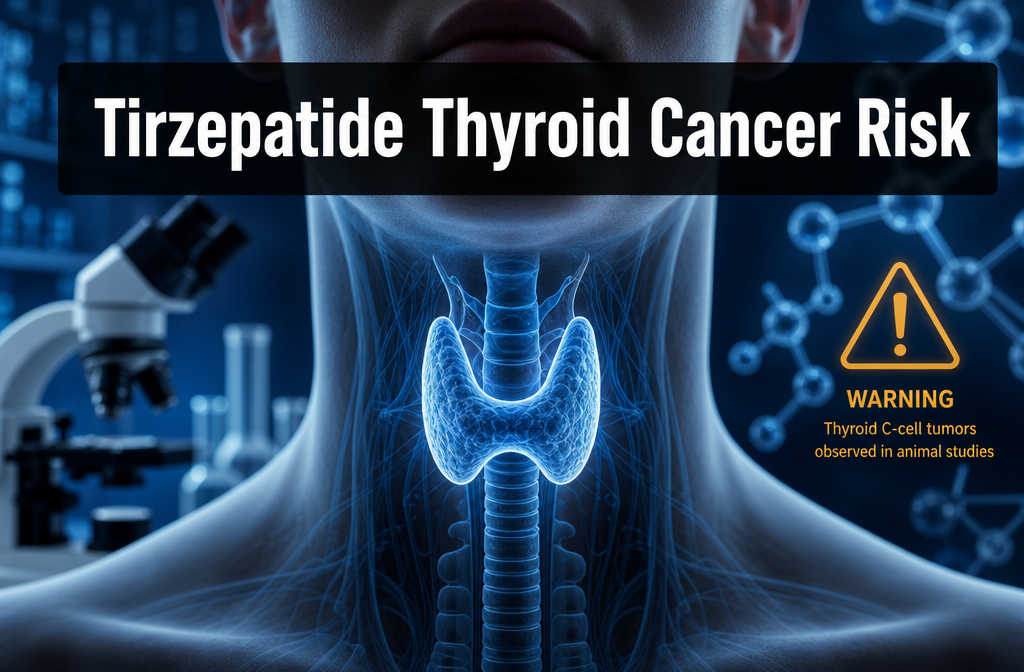
Does Tirzepatide Causes Thyroid Cancer?
Quick Answer: Tirzepatide carries an FDA boxed warning about thyroid C-cell tumours based on rodent studies, but no confirmed causal link to thyroid cancer in humans has been established as of 2026. The warning specifically applies to people with a personal or family history of medullary thyroid carcinoma (MTC) or multiple endocrine neoplasia type 2 (MEN2), who should not use tirzepatide. For everyone else, the absolute risk appears low, though ongoing monitoring is recommended.
Key Takeaways
- Tirzepatide’s thyroid cancer warning comes from animal studies, not confirmed human cases [7]
- The FDA boxed warning covers all GLP-1 receptor agonists, including semaglutide (Ozempic/Wegovy) and liraglutide [1]
- People with a personal or family history of MTC or MEN2 must not use tirzepatide
- Research suggests some apparent increase in thyroid cancer diagnoses among GLP-1 users may reflect “detection bias” rather than true causation [3]
- Early warning signs include a neck lump, persistent hoarseness, or difficulty swallowing
- Thyroid monitoring is advisable before and during treatment, especially for higher-risk individuals
- Endocrinologists generally do not consider tirzepatide a high thyroid cancer risk for the general population, provided contraindications are respected [4]
- No study has definitively proven tirzepatide causes thyroid cancer in humans [7]
- Stopping tirzepatide does not guarantee reduced thyroid cancer risk, as causation has not been confirmed
- Discussing personal risk factors with a healthcare provider before starting is essential
What Is the Tirzepatide Thyroid Cancer Risk, and Where Does It Come From?
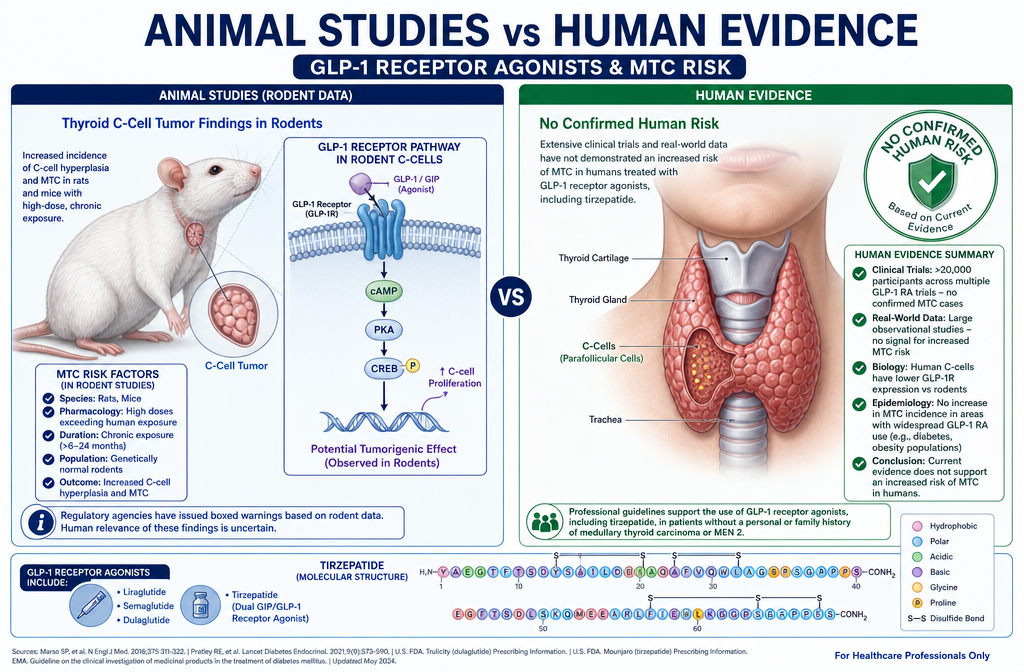
The tirzepatide thyroid cancer risk originates from preclinical rodent studies, not from confirmed human cancer cases. In those studies, rats and mice given GLP-1 receptor agonists (including tirzepatide) developed thyroid C-cell tumours at doses higher than those used therapeutically in humans. As a result, the U.S. Food and Drug Administration (FDA) mandated a class boxed warning for all drugs in this category [7].
What the warning actually says:
- Tirzepatide (branded as Mounjaro and Zepbound) carries a boxed warning for “thyroid C-cell tumours”
- The warning is a precautionary measure, not a confirmed diagnosis of risk in humans
- It applies across the entire GLP-1 receptor agonist drug class, not just tirzepatide specifically
Why rodent data doesn’t automatically translate to humans:
Rodents express GLP-1 receptors in thyroid C-cells at much higher densities than humans do. This biological difference is significant. The FDA itself acknowledges that it is unknown whether tirzepatide causes thyroid tumours or medullary thyroid carcinoma in humans [7]. The warning exists because the risk cannot be ruled out, not because it has been proven.
Important Medical Warning: Contact your healthcare provider promptly if you notice a lump or swelling in your neck, persistent hoarseness, difficulty swallowing, or shortness of breath. These symptoms may require medical evaluation. In animal studies, tirzepatide and similar medications were associated with thyroid tumours. It is not known whether TIRZEPARO® causes thyroid tumours or medullary thyroid carcinoma (MTC) in humans. You must be 18+ to use our service.
Does Tirzepatide Cause Thyroid Cancer Like Ozempic?
Tirzepatide and semaglutide (Ozempic) share the same FDA boxed warning class for thyroid C-cell tumours, but neither has been proven to cause thyroid cancer in humans. The shared warning reflects their shared mechanism — both activate GLP-1 receptors — rather than confirmed clinical evidence of harm [1].
Comparing the two drugs on thyroid risk:
| Feature | Tirzepatide (Mounjaro) | Semaglutide (Ozempic/Wegovy) |
|---|---|---|
| Drug class | Dual GIP + GLP-1 agonist | GLP-1 agonist |
| FDA boxed warning | Yes — thyroid C-cell tumours | Yes — thyroid C-cell tumours |
| Human causation confirmed | No | No |
| MTC/MEN2 contraindication | Yes | Yes |
| Rodent tumour data | Yes | Yes |
A key distinction: tirzepatide also activates GIP receptors, making it a dual agonist. Whether this dual action changes the thyroid risk profile compared to GLP-1-only drugs is not yet established by human clinical data [4]. For a broader comparison of these two medications, see this tirzepatide vs semaglutide comparison guide.
What Studies Show a Thyroid Cancer Connection to This Drug?
Several observational studies have examined the association between GLP-1 receptor agonists and thyroid cancer, but none have confirmed a direct causal link for tirzepatide specifically [3][4].
Key findings from the available research:
- A study reviewed by Mayo Clinic researchers found that higher rates of thyroid cancer diagnoses among GLP-1 users may be explained by detection bias — people taking these medications are monitored more closely, meaning thyroid abnormalities are found that would otherwise go undetected [3]
- Research published in cancer-focused medical literature noted that while some population-level studies show a statistical association between GLP-1 use and thyroid cancer diagnoses, the absolute numbers remain small and confounding factors are significant [4]
- A 2025 study in the Journal of the Endocrine Society examined GLP-1 receptor agonist use and thyroid outcomes, noting that the biological plausibility of human risk remains limited given the lower GLP-1 receptor density in human thyroid tissue compared to rodents [2]
- Tirzepatide’s own clinical trial programme (SURMOUNT and SURPASS series) did not identify a statistically significant increase in thyroid cancer cases compared to placebo [7]
Common mistake: Treating observational associations as proof of causation. Correlation in population data does not confirm that tirzepatide causes thyroid cancer. Confounding variables — including increased medical surveillance, BMI-related cancer risk, and pre-existing thyroid conditions — complicate interpretation [3].
What Are My Chances of Thyroid Tumour Risk With This Medication?
For most people without specific risk factors, the absolute risk of developing thyroid cancer from tirzepatide appears to be very low, though a precise percentage cannot be stated because human causation has not been confirmed [7].
What the data suggests:
- Thyroid cancer, particularly medullary thyroid carcinoma, is rare in the general population
- Clinical trials for tirzepatide did not show a statistically significant increase in thyroid cancer incidence [7]
- The apparent increase seen in some observational studies is likely partly or wholly explained by detection bias [3]
Risk is not zero — but context matters:
The FDA warning exists precisely because absolute safety in humans cannot be guaranteed based on current evidence. Anyone with elevated baseline risk (see the section below on who should avoid tirzepatide) faces a different risk calculation than the general population.
Who Should Definitely Avoid Tirzepatide Because of Thyroid Concerns?
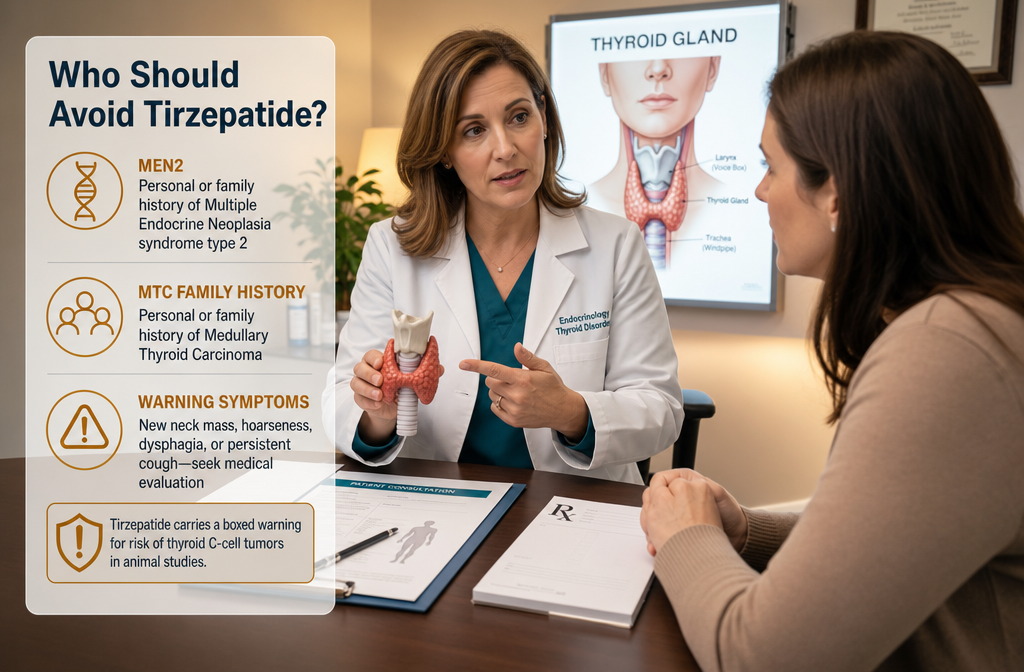
Certain individuals must not use tirzepatide due to thyroid-related contraindications. This is the clearest, most actionable guidance from regulators and clinicians.
Absolute contraindications:
- Personal history of medullary thyroid carcinoma (MTC): If you have previously been diagnosed with MTC, tirzepatide is contraindicated
- Family history of MTC: A first-degree relative with MTC significantly elevates risk and is a contraindication
- Multiple endocrine neoplasia type 2 (MEN2): This genetic syndrome, which predisposes individuals to MTC, is a firm contraindication for all GLP-1 receptor agonists including tirzepatide [7]
Who should proceed with extra caution and medical supervision:
- People with existing thyroid nodules or goitre
- Individuals with a history of other thyroid conditions (hypothyroidism, hyperthyroidism)
- Those with a family history of thyroid disease more broadly
- People who have previously undergone thyroid surgery or radiation
Decision rule: If you have MTC or MEN2 in your personal or family history, tirzepatide is not appropriate for you. If you have other thyroid conditions, a conversation with an endocrinologist or your GP before starting is strongly advisable.
Can People With a Family History of Thyroid Cancer Take Tirzepatide?
People with a family history of medullary thyroid carcinoma (MTC) specifically should not take tirzepatide. However, a family history of other thyroid cancers (such as papillary or follicular thyroid cancer, which are far more common) does not automatically disqualify someone from using the medication [7][4].
The distinction matters:
- MTC is the specific cancer type linked to GLP-1 receptor agonist risk in animal studies
- Papillary and follicular thyroid cancers are not the same as MTC and are not the focus of the boxed warning
- MEN2 syndrome, which is hereditary, dramatically increases MTC risk and is a hard contraindication
Edge case: If you are unsure whether a family member’s thyroid cancer was MTC or another type, request genetic counselling or ask your GP to review family medical records before starting tirzepatide.
What Are the Early Warning Signs of Thyroid Problems on This Medication?
The early warning signs of thyroid tumour development are the same regardless of medication, but they are especially important to monitor when using tirzepatide. Catching these symptoms early is critical.
Symptoms that require prompt medical attention:
- A lump, mass, or swelling in the front of the neck
- Persistent hoarseness or changes in voice quality
- Difficulty swallowing (dysphagia)
- Shortness of breath without obvious cause
- Neck pain that radiates to the ears
What to do if you notice these symptoms:
- Stop and contact a healthcare provider promptly — do not wait for a scheduled appointment
- Do not assume symptoms are unrelated to your medication
- A physical examination and possibly an ultrasound or blood test (calcitonin levels) may be ordered
These symptoms do not confirm cancer — they can have many causes — but they warrant evaluation. For more on what to expect at different doses, see the effects of Tirzepatide 7.5mg and effects of Tirzepatide 10mg guides.
How Long Do You Need to Monitor for Potential Thyroid Issues After Starting Tirzepatide?
There is no universally agreed monitoring period, but most clinical guidance suggests ongoing vigilance for as long as tirzepatide is used, with baseline assessment before starting [4].
Practical monitoring framework:
- Before starting: Discuss any thyroid history with a healthcare provider; consider baseline thyroid function tests if there is a relevant history
- First 6 months: Be particularly alert to any neck changes or new symptoms as the body adjusts to the medication
- Ongoing: Annual thyroid check-ups are reasonable for anyone on long-term tirzepatide therapy, especially those with pre-existing thyroid conditions
- After stopping: No specific monitoring period is mandated post-discontinuation, as causation in humans has not been confirmed
Common mistake: Assuming that because symptoms haven’t appeared in the first few weeks, no monitoring is needed going forward. Thyroid changes can be slow-developing.
What Percentage of Patients Experience Thyroid-Related Side Effects?
Thyroid-related side effects are not commonly reported in tirzepatide clinical trials. The SURMOUNT and SURPASS trial programmes did not identify thyroid cancer as a frequent adverse event, and the incidence of any thyroid-related adverse events was low [7].
What clinical trial data shows:
- Thyroid cancer cases in tirzepatide trials were rare and not statistically different from placebo groups
- The most commonly reported side effects are gastrointestinal (nausea, diarrhoea, vomiting) — not thyroid-related
- Elevated calcitonin (a potential marker for C-cell activity) was monitored in trials; significant elevations were uncommon [7]
A precise population-level percentage for thyroid side effects cannot be stated with confidence given the detection bias issue identified in observational studies [3]. What can be said is that thyroid cancer is not among the commonly reported adverse events in controlled trial settings.
How Does Tirzepatide Compare to Other Diabetes Drugs for Thyroid Cancer Risk?
Tirzepatide’s thyroid cancer risk profile is comparable to other GLP-1 receptor agonists and is not considered elevated compared to older diabetes medications like metformin, SGLT-2 inhibitors, or DPP-4 inhibitors, which do not carry the same thyroid C-cell warning [4].
Comparison overview:
| Drug Class | Examples | Thyroid C-cell Warning | MTC Contraindication |
|---|---|---|---|
| Dual GIP/GLP-1 agonist | Tirzepatide (Mounjaro) | Yes | Yes |
| GLP-1 agonist | Semaglutide, Liraglutide | Yes | Yes |
| SGLT-2 inhibitor | Dapagliflozin, Empagliflozin | No | No |
| DPP-4 inhibitor | Sitagliptin, Alogliptin | No | No |
| Biguanide | Metformin | No | No |
Choose tirzepatide if: You do not have MTC or MEN2 history and want a dual-mechanism metabolic health support option. Consider alternatives if: You have thyroid contraindications or strong concerns about the GLP-1 pathway warning.
Are There Alternative Diabetes Medications With Lower Thyroid Cancer Risk?
Yes. Several effective metabolic health medications do not carry the GLP-1-related thyroid C-cell warning. The right choice depends on individual health goals, existing conditions, and medical guidance.
Alternatives without the thyroid C-cell boxed warning:
- SGLT-2 inhibitors (e.g., empagliflozin, dapagliflozin): Effective for blood glucose management and cardiovascular benefit, no thyroid C-cell warning
- DPP-4 inhibitors (e.g., sitagliptin): Generally well-tolerated, no thyroid warning
- Metformin: Long-established, no thyroid cancer concern, though less effective for appetite management than GLP-1 drugs
The trade-off: GLP-1 receptor agonists, including tirzepatide, generally produce more significant appetite management and body composition benefits than the alternatives listed above. For individuals without thyroid contraindications, the precautionary warning alone is not typically considered a reason to avoid tirzepatide in clinical practice [4].
Can Stopping Tirzepatide Reduce My Thyroid Cancer Risk?
Stopping tirzepatide will remove ongoing GLP-1 receptor stimulation, but there is no confirmed evidence that this reduces thyroid cancer risk because human causation has not been established [7].
What stopping tirzepatide does and doesn’t do:
- It removes the theoretical ongoing stimulus to thyroid C-cells (based on animal data)
- It does not reverse any thyroid changes that may have already occurred
- It does not guarantee reduced cancer risk because the drug has not been proven to cause thyroid cancer in humans
- Stopping for thyroid cancer concerns alone, without a clinical reason, means losing the metabolic health benefits of the medication
Practical guidance: If you are concerned about thyroid risk, the right step is to speak with a healthcare provider rather than stopping abruptly. A clinical assessment of your individual risk factors is far more useful than discontinuation based on general concern.
What Do Endocrinologists Recommend About Tirzepatide and Thyroid Health?
Endocrinologists generally consider tirzepatide safe for people without MTC or MEN2 history, while recommending appropriate screening and symptom awareness [3][4].
The mainstream clinical position in 2026:
- The thyroid C-cell warning is taken seriously but is not considered a reason to avoid tirzepatide in low-risk individuals
- Detection bias is widely acknowledged as a likely contributor to apparent increases in thyroid cancer diagnoses among GLP-1 users [3]
- Baseline thyroid assessment is recommended for anyone with a thyroid history before starting
- Ongoing monitoring for symptoms is considered good practice
- The risk-benefit calculation for most eligible patients favours tirzepatide’s metabolic health benefits over the theoretical thyroid risk [4]
For those exploring tirzepatide access, understanding tirzepatide costs in the UK and where to buy tirzepatide online are practical next steps once you have confirmed your eligibility with a healthcare provider.
FAQ: Tirzepatide Thyroid Cancer Risk
Q: Is tirzepatide proven to cause thyroid cancer in humans?
No. As of 2026, no study has confirmed that tirzepatide causes thyroid cancer in humans. The FDA boxed warning is based on rodent studies, not human clinical evidence [7].
Q: What type of thyroid cancer is linked to tirzepatide in animal studies?
Medullary thyroid carcinoma (MTC), which originates in thyroid C-cells. This is a rare type of thyroid cancer, distinct from the more common papillary and follicular thyroid cancers [7].
Q: Can I take tirzepatide if my mother had thyroid cancer?
It depends on the type. If she had MTC, you should not take tirzepatide. If she had papillary or follicular thyroid cancer, it is not an automatic contraindication, but discuss it with your GP or endocrinologist first.
Q: How is the thyroid cancer risk from tirzepatide different from other GLP-1 drugs?
It is not meaningfully different. All GLP-1 receptor agonists share the same class boxed warning. Tirzepatide’s dual GIP/GLP-1 mechanism has not been shown to increase thyroid risk beyond that of GLP-1-only drugs [1][4].
Q: Should I get a thyroid scan before starting tirzepatide?
Not routinely required for everyone, but advisable if you have a personal or family history of thyroid conditions. Speak with a healthcare provider to assess your individual situation.
Q: What is calcitonin and why does it matter for tirzepatide users?
Calcitonin is a hormone produced by thyroid C-cells. Elevated calcitonin can be an early marker of C-cell activity or MTC. Some clinicians recommend monitoring calcitonin levels in patients on GLP-1 receptor agonists, particularly those with risk factors.
Q: Does the dose of tirzepatide affect thyroid cancer risk?
There is no confirmed dose-response relationship for thyroid cancer risk in humans. In rodent studies, higher doses produced more tumours, but this has not been replicated in human clinical data. See the effects of Tirzepatide 5mg and effects of Tirzepatide 2.5mg for dose-specific information.
Q: Is the increased thyroid cancer rate seen in some studies real?
Possibly partly real, but largely explained by detection bias — people on tirzepatide and similar drugs are monitored more closely, so pre-existing or slow-growing thyroid cancers are found that would otherwise go undetected [3].
Q: What should I do if I feel a lump in my neck while taking tirzepatide?
Contact a healthcare provider promptly. Do not wait. A lump in the neck requires evaluation regardless of what medication you are taking.
Q: Can I take tirzepatide if I have hypothyroidism?
Hypothyroidism is not a contraindication for tirzepatide. However, inform your prescriber so they can monitor thyroid function appropriately.
Conclusion: Putting the Tirzepatide Thyroid Cancer Risk in Perspective
The tirzepatide thyroid cancer risk is real enough to warrant a regulatory warning and genuine informed consent — but it is not, based on current evidence, a confirmed human cancer risk for most people. The FDA boxed warning stems from animal studies conducted in species with fundamentally different thyroid biology to humans. Human clinical trials have not demonstrated a statistically significant increase in thyroid cancer cases [7], and researchers increasingly point to detection bias as a key driver of the associations seen in observational data [3].
Actionable next steps:
- Know your contraindications. If you have a personal or family history of MTC or MEN2, tirzepatide is not for you — full stop.
- Get a baseline check. If you have any thyroid history, discuss it with a GP or endocrinologist before starting.
- Learn the warning signs. Neck lumps, hoarseness, and difficulty swallowing deserve prompt medical attention.
- Monitor consistently. Ongoing awareness throughout your metabolic health journey is more valuable than a one-off assessment.
- Make an informed decision. For most eligible adults without thyroid contraindications, the available evidence does not support avoiding tirzepatide solely on the basis of thyroid cancer concern.
If you are considering tirzepatide as part of your body composition management journey and want to understand more about the product range and pricing, explore the Tirzeparo product range or take the eligibility test to see whether this option may be suitable for you.
Sourcing Disclaimer: Tirzeparo acts as a bridge, providing direct access to affordable Tirzepatide by fulfilling orders through our network of EU partners. We are not a medical clinic; we are your sourcing solution.
References
[1] Do GLP-1 Weight Loss Shots Like Ozempic And Mounjaro Really Raise Thyroid Cancer Risk – https://www.thyroidcancer.com/blog/do-glp-1-weight-loss-shots-like-ozempic-and-mounjaro-really-raise-thyroid-cancer-risk
[2] Journal of the Endocrine Society — GLP-1RA and Thyroid Outcomes Study – https://academic.oup.com/jes/article/9/Supplement_1/bvaf149.2358/8298558
[3] Mayo Clinic — GLP-1RA and Thyroid Cancer: New Study Suggests Detection Bias, Not Causation – https://www.mayoclinic.org/medical-professionals/endocrinology/news/glp-1ra-and-thyroid-cancer-new-study-suggests-detection-bias-not-causation/mac-20587812
[4] Cancer Network — Evaluating Thyroid Cancer Risk After GLP-1 Receptor Agonist Administration – https://www.cancernetwork.com/view/evaluating-thyroid-cancer-risk-after-glp-1-receptor-agonist-administration
[7] Drugs.com — Does Tirzepatide Cause Cancer? – https://www.drugs.com/medical-answers/tirzepatide-cause-cancer-3582083/